

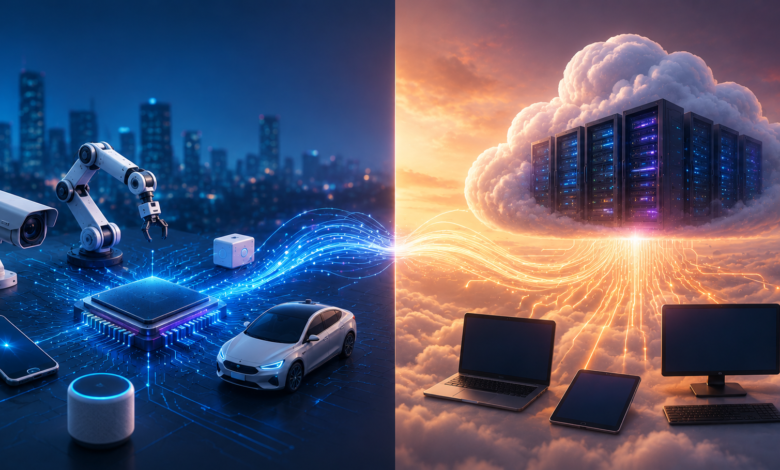
Edge AI vs Cloud AI | Which Technology Will Dominate the Future
Artificial Intelligence is transforming industries worldwide, but businesses now face an important decision: should they use Edge AI or Cloud AI? Both technologies offer powerful capabilities, yet they differ significantly in speed, privacy, cost, and performance.
As AI adoption continues to grow in 2026, understanding the differences between Edge AI and Cloud AI is essential for businesses, developers, and technology enthusiasts. This guide explains how each technology works, its advantages, disadvantages, and what the future may hold.
What Is Edge AI?
Edge AI refers to artificial intelligence that processes data directly on local devices rather than sending it to remote servers.
Examples of Edge AI devices include:
- Smartphones
- Security cameras
- Smart home devices
- Autonomous vehicles
- Industrial sensors
- Wearable technology
Instead of relying on internet connectivity, Edge AI performs calculations and decision-making locally.
How Edge AI Works
Data Processing on the Device
Data is collected and analyzed directly on the hardware device.
Faster Responses
Since information doesn’t travel to distant servers, response times are significantly reduced.
Reduced Internet Dependency
Edge AI can continue functioning even with limited or no internet access.
What Is Cloud AI?
Cloud AI processes information on powerful remote servers hosted by cloud providers.
Popular cloud platforms include:
- Google Cloud AI
- Microsoft Azure AI
- Amazon Web Services AI
- IBM Watson
Devices send data to cloud servers where advanced AI models analyze it and return results.
How Cloud AI Works
Centralized Processing
Large AI models run on high-performance cloud infrastructure.
Massive Computing Power
Cloud servers can handle complex calculations beyond the capabilities of local devices.
Continuous Updates
AI models can be updated instantly without modifying individual devices.
Edge AI vs Cloud AI: Key Differences
Speed and Latency
Edge AI Advantage
Edge AI delivers near-instant responses because data remains on the device.
Examples include:
- Self-driving cars
- Smart surveillance systems
- Industrial automation
Cloud AI Limitation
Cloud AI requires internet communication, which introduces latency.
Data Privacy and Security
Edge AI Advantage
Sensitive information remains on local devices, reducing exposure risks.
This makes Edge AI attractive for:
- Healthcare
- Banking
- Government applications
Cloud AI Considerations
Data must be transmitted and stored remotely, increasing security responsibilities.
Processing Power
Cloud AI Advantage
Cloud platforms provide virtually unlimited computational resources.
They can run:
- Large language models
- Complex analytics
- Advanced machine learning systems
Edge AI Limitation
Local devices have hardware constraints that limit model size and complexity.
Cost Comparison
Edge AI Costs
Higher initial hardware investment may be required.
However, ongoing cloud service expenses can be reduced.
Cloud AI Costs
Lower hardware requirements, but recurring cloud subscription and data transfer costs.
Real-World Applications of Edge AI
Smart Cities
Traffic monitoring systems use Edge AI to analyze road conditions in real time.
Healthcare Devices
Wearable devices monitor patient health without continuously transmitting sensitive data.
Autonomous Vehicles
Self-driving cars require instant decision-making that cannot depend solely on cloud connectivity.
Manufacturing
Factories use Edge AI for predictive maintenance and quality control.
Real-World Applications of Cloud AI
AI Chatbots
Cloud infrastructure powers advanced conversational AI systems.
Big Data Analytics
Organizations analyze massive datasets using cloud computing resources.
Content Generation
AI writing, image generation, and video creation tools often rely on cloud processing.
Enterprise Software
Large businesses use cloud AI for customer service, sales forecasting, and workflow automation.
Advantages of Edge AI
Faster Processing
Real-time decision-making improves performance in critical applications.
Better Privacy
Data remains on local devices.
Reduced Bandwidth Usage
Less information needs to be transmitted online.
Offline Functionality
Systems can continue operating without internet access.
Advantages of Cloud AI
Scalability
Resources can expand as demand grows.
Powerful AI Models
Cloud environments support advanced machine learning systems.
Lower Device Requirements
Devices can remain lightweight while leveraging powerful remote infrastructure.
Easy Maintenance
Updates and improvements occur centrally.
Challenges Facing Both Technologies
Edge AI Challenges
Hardware Limitations
Local devices have restricted processing capabilities.
Higher Deployment Costs
Advanced hardware may increase initial investment.
Cloud AI Challenges
Latency Issues
Network delays can affect performance.
Privacy Concerns
Sensitive data must travel through external networks.
The Future of AI: Hybrid Systems
Experts believe the future belongs to hybrid AI systems that combine both Edge AI and Cloud AI.
In a hybrid approach:
- Edge AI handles real-time decisions.
- Cloud AI manages advanced analysis and long-term learning.
This combination provides:
- Faster performance
- Improved privacy
- Greater scalability
- Better overall efficiency
Will Edge AI Replace Cloud AI?
The answer is likely no.
Instead of replacing each other, Edge AI and Cloud AI will continue working together. Different applications require different solutions, and hybrid architectures are becoming the preferred choice for many organizations.
Conclusion
The Edge AI vs Cloud AI debate is not about choosing a winner. Both technologies offer unique advantages and serve different purposes.
Edge AI excels in speed, privacy, and real-time decision-making, while Cloud AI provides unmatched computational power and scalability. As technology advances, hybrid systems will likely become the standard approach, delivering the best of both worlds.
Businesses that understand these technologies today will be better prepared for the AI-driven future of tomorrow.
loud AI will dominate future deployments.