Edge AI vs Cloud AI at a Glance
| Factor | Edge AI | Cloud AI |
|---|---|---|
| Where inference runs | On or near the device generating the data | Centralized or regional cloud/data-center infrastructure |
| Latency | Can be very low because network round trips can be reduced | Depends on network, geography, congestion, and cloud architecture |
| Connectivity | Can support local decisions during connectivity interruptions | Usually depends on network access to the service |
| Compute capacity | Limited by device or nearby edge hardware | Much greater access to scalable centralized compute |
| Privacy | Can keep some sensitive processing local | Centralized processing may require sending data to remote infrastructure |
| Updates and management | Can be harder across many distributed devices | Centralized updates are generally easier to coordinate |
| Best fit | Real-time, localized, offline-sensitive inference | Large models, centralized analysis, training, and scalable services |
What Is Edge AI?
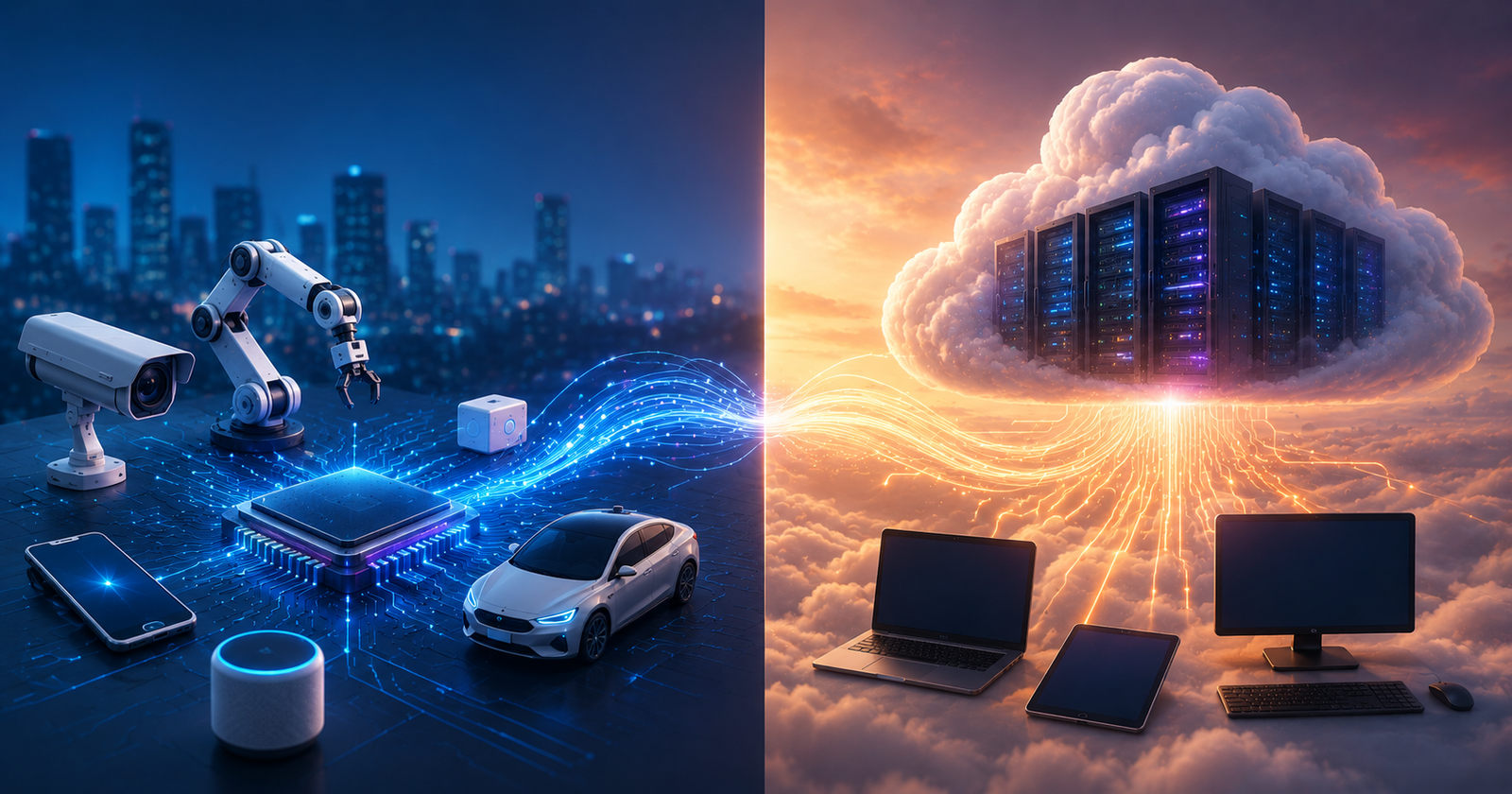
Edge AI performs AI inference on or near the device that generates the data. Examples include a smartphone analyzing an image, a factory system detecting an equipment anomaly locally, or an embedded automotive system processing sensor information without sending every raw input to a remote cloud service.The main advantage is architectural proximity. When inference happens near the data source, the system can reduce network dependency, limit the amount of information that must be transmitted, and make decisions without waiting for a remote round trip.That can be especially useful for:- Industrial automation
- Robotics
- Automotive systems
- Smart cameras
- Wearables
- Healthcare monitoring
- Retail analytics
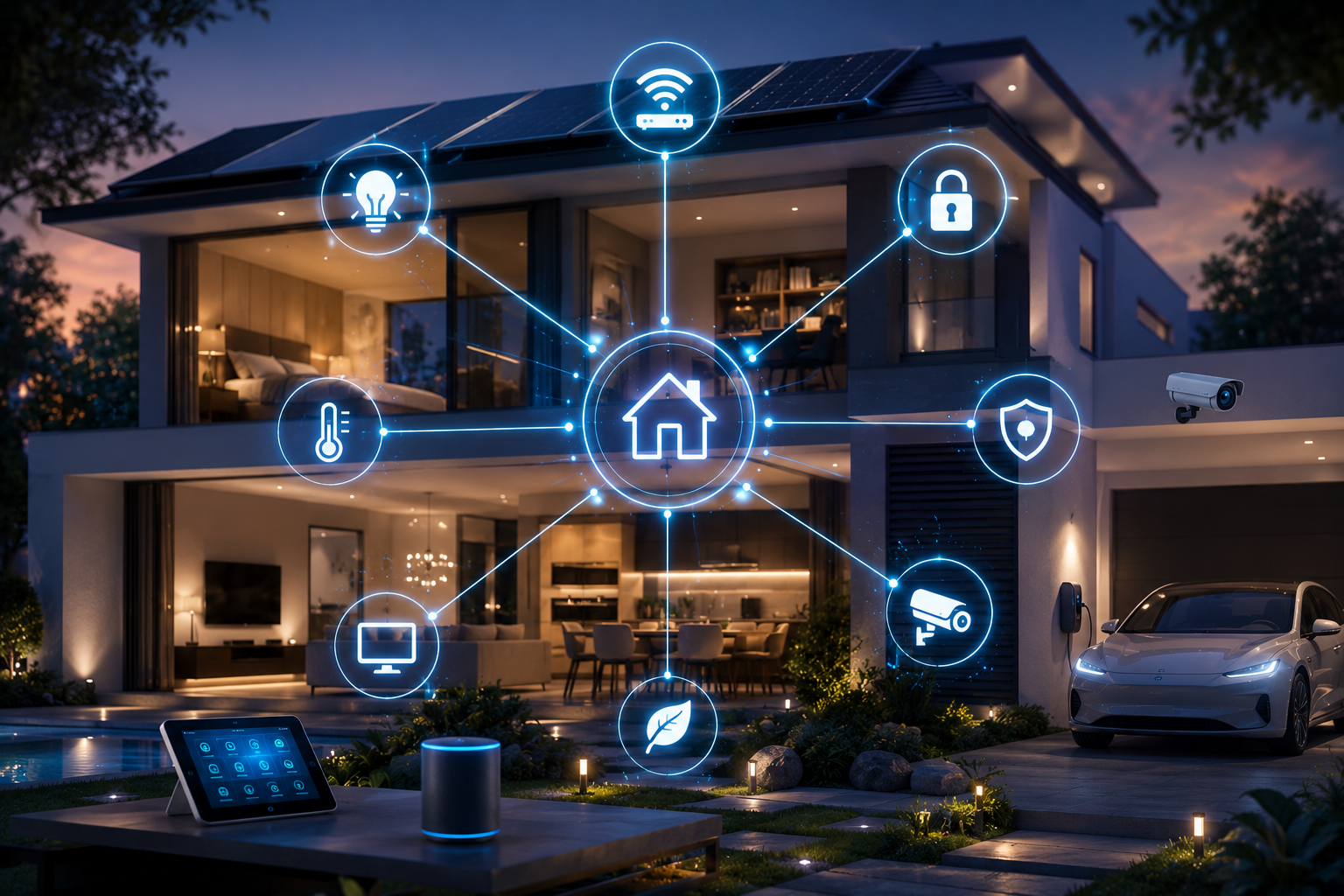
- Smart-home devices
What Is Cloud AI?
Cloud AI uses centralized or regional computing infrastructure to train models, serve inference requests, aggregate data, and provide AI capabilities at scale.The cloud has a major advantage when a workload needs more memory, compute, storage, or model capacity than an individual device can reasonably provide.Large-scale model training generally relies on centralized data-center infrastructure because frontier models require enormous quantities of compute, memory, storage, and networking.Cloud AI is also useful when an organization wants centralized governance, shared models, consistent software versions, and a common service that can be accessed by many devices or users.Edge AI Is Growing Quickly
Market research points to strong growth in Edge AI, although the exact market size varies by methodology.Grand View Research estimates that the global Edge AI market was worth $24.9 billion in 2025, is estimated at $30.0 billion in 2026, and could reach $118.7 billion by 2033, representing a projected 21.7% CAGR from 2026 to 2033.Grand View Research also estimates that North America accounted for about 36.0% of global Edge AI revenue in 2025 and that hardware represented about 51.8% of the market that year.A separate estimate from Precedence Research puts the 2025 Edge AI market at $25.65 billion and projects about $165.05 billion by 2035, with a 20.46% CAGR. The difference between the estimates illustrates why market figures should be treated as methodology-specific rather than as a single universal number.Edge AI Hardware Is Expanding
The hardware ecosystem is also becoming larger as more devices gain local AI acceleration.MarketsandMarkets estimates the global Edge AI hardware market at $26.14 billion in 2025 and projects it to reach $58.90 billion by 2030, a 17.6% CAGR.The market includes processors, accelerators, NPUs, SoCs, edge modules, and other hardware used to perform AI inference closer to the data source.This growth matters because improved local compute makes it possible to run increasingly capable models without sending every request to the cloud.Broader Edge Computing Spending Is Growing Too
Edge AI is part of a larger shift toward distributed computing infrastructure.IDC forecast global spending on edge computing solutions at nearly $261 billion in 2025, growing at a 13.8% CAGR to about $380 billion by 2028.IDC’s broader edge category includes more than AI inference. It covers edge-related hardware, software, services, and other infrastructure. Therefore, the figure should not be treated as Edge AI spending alone.Where Edge AI Has the Strongest Advantage: Latency
Latency is one of the clearest reasons to move inference closer to the data source.A study published on arXiv reports an illustrative comparison of roughly 5–10 milliseconds for edge inference versus approximately 100–500 milliseconds for cloud round trips. Those numbers are from a comparative analysis, not universal industry benchmarks.Actual end-to-end latency depends on:- Device hardware
- Model size
- Network type
- Geographic distance
- Cloud-region selection
- Network congestion
- Optimization and batching
- Pre-processing and post-processing
Why That Matters in Real-Time Systems
Applications such as industrial robotics, machine vision, autonomous systems, and certain medical-monitoring workflows may need decisions to happen quickly and reliably.In these environments, waiting for a remote service can introduce a dependency that is undesirable or unacceptable. Edge inference can provide a local response while still allowing the system to use cloud infrastructure for other tasks.Cloud infrastructure can also be deployed closer to users through regional or near-edge services, so the choice is not simply “device versus distant data center.” Architecture and geography both matter.Edge AI Can Reduce Network Dependence
Sending every sensor reading, video frame, or audio stream to a remote service can create bandwidth and networking requirements.Edge processing can filter, compress, classify, or act on information locally before sending selected results upstream.That does not mean all edge deployments eliminate cloud traffic. A more realistic architecture often looks like this:- Raw or high-frequency data is processed locally.
- Important events or summaries are transmitted upstream.
- Cloud services aggregate information across devices.
- New models or policies are distributed back to edge systems.
Privacy: Edge Can Help, but It Does Not Guarantee Security
One advantage of local inference is that sensitive information can sometimes be processed without leaving the device or local environment.That can reduce the amount of raw personal, operational, or biometric data sent to a central service.However, saying that Edge AI is automatically safer than Cloud AI would be misleading. Edge devices introduce their own security challenges, including physical access, firmware integrity, device authentication, distributed patching, and management of large device fleets.Cloud providers can also offer strong security controls, centralized monitoring, encryption, identity management, and compliance infrastructure.The relevant question is therefore not simply where the data is processed. It is how the complete system is secured.Where Cloud AI Still Has a Major Advantage
1. Large-Scale Model Training
Training frontier or large enterprise models requires enormous compute and storage resources. Centralized infrastructure is much better suited to this task than individual edge devices.2. Large and Complex Models
Cloud systems can provide much more memory and compute than typical endpoint hardware. This makes them appropriate for models that are too large or computationally expensive to run locally.3. Centralized Model Management
Cloud infrastructure makes it easier to update a model once and make that version available to many users or devices, rather than coordinating a large number of separate physical systems.4. Cross-Device Analytics
When an organization needs to analyze information from thousands or millions of devices together, centralized systems provide an efficient place to aggregate and analyze the resulting data.5. Workloads That Do Not Require Immediate Response
If an AI task can tolerate network latency and does not need local operation, cloud processing can be simpler to manage than distributed edge infrastructure.Cost: There Is No Universal Edge vs Cloud Winner
The original article used fixed cloud request and data-egress prices and a universal 30–50% five-year Edge AI TCO advantage. Those figures have been removed because AI pricing varies by provider, model, token or workload volume, region, storage architecture, contract, and network pattern.A more useful cost comparison considers:| Cost factor | Edge AI | Cloud AI |
|---|---|---|
| Upfront hardware | Can be significant across a large device fleet | Less local hardware required |
| Connectivity | Can reduce recurring data transmission | Network transfer and service costs can grow with volume |
| Inference | Local compute has hardware and energy costs | Usage is generally billed according to provider/model pricing |
| Maintenance | Many distributed devices must be monitored and updated | Central infrastructure is easier to manage at scale |
| Scaling | May require additional hardware deployments | Central resources can often scale more dynamically |
Edge Hardware Is Becoming More Capable
AI PCs, smartphones, industrial devices, automotive systems, and dedicated edge accelerators are increasingly adding local AI processing capability.Instead of claiming that 50 TOPS has already become a universal enterprise standard, the safer conclusion is that AI hardware with dedicated NPUs and tens of TOPS of local AI performance is increasingly available.This matters because higher local compute allows more AI inference to move onto endpoints without requiring a remote request for every task.Enterprise Adoption Is Moving Forward
A 2025 ZEDEDA survey conducted by Censuswide among 301 U.S. CIOs found that 97% had Edge AI either already deployed or on their roadmap.The same survey found that 90% of organizations were increasing Edge AI budgets for 2025, including 30% reporting increases of 25% or more.These figures are useful indicators of enterprise interest, but they are survey results from a vendor-sponsored study rather than a census of all U.S. companies.The survey also found that security and data privacy were the leading reason cited for Edge AI investment, while security and data-protection concerns remained a major implementation challenge. That is an important reminder that the edge is not automatically secure simply because processing happens locally.Regional Market Dynamics
Grand View Research estimates that North America held approximately 36.0% of global Edge AI revenue in 2025, making it the leading region in that dataset.Precedence Research also places North America first in 2025, with an estimated 40% share, while projecting Asia Pacific to be the fastest-growing region over its forecast period.The difference between 36% and 40% illustrates the importance of methodology. The broader trend is more useful than treating one percentage as a universal measurement.The China Patent Statistic Needs Careful Interpretation
The original article incorrectly described China’s share of global AI patent grants as an Edge AI patent figure.Stanford’s AI Index reports that China accounted for 69.7% of granted AI patents in 2023, with the United States at 14.2%. That is a statistic about AI patents broadly, not Edge AI specifically.For the Edge AI article, the broader patent statistic is not essential. It is therefore better to avoid presenting China’s general AI patent share as evidence that China holds a specific Edge AI patent lead.Stanford’s 2025 AI Index reported that China accounted for 69.7% of granted AI patents in 2023. Stanford’s subsequent AI Index reporting continues to identify China as the leading country by AI patent volume, while the United States remains stronger on measures such as leading AI models and higher-impact patents.Why Hybrid Architectures Are the Practical Future
The most useful way to think about Edge AI and Cloud AI is as parts of a single distributed architecture.A hybrid system can divide tasks based on what each environment does best.At the Edge
- Low-latency inference
- Immediate local decisions
- Offline or intermittent-connectivity operation
- Local filtering of high-volume sensor data
- Processing that benefits from keeping raw data local
In the Cloud
- Large-scale model training
- Centralized analytics
- Cross-device learning
- Model distribution and management
- Large or computationally intensive inference
- Long-term storage and organization-wide reporting
How Organizations Should Choose Between Edge and Cloud
Before selecting an architecture, evaluate the workload against a few practical questions.Does the application require very predictable response time?
If yes, local inference may have a significant advantage because it reduces reliance on unpredictable network round trips.Does the model require substantial compute or memory?
If yes, centralized infrastructure may be the better fit.Is connectivity unreliable?
If yes, local inference can provide resilience when a network connection is unavailable or degraded.Is the data highly sensitive?
If yes, keeping some processing local may reduce unnecessary transmission, but the entire security architecture still needs to be evaluated.Does the system involve thousands of distributed devices?
If yes, centralized management becomes important. Edge deployments need strong device-management, monitoring, update, identity, and security processes.What does the total cost look like?
Calculate hardware, maintenance, power, bandwidth, cloud usage, software, personnel, and lifecycle costs rather than comparing a single inference price.Practical Examples
Autonomous Vehicle
A vehicle may need local inference for immediate perception and control while using cloud infrastructure for fleet analytics, model improvement, mapping, and software distribution.Smart Factory
A production line can analyze cameras and sensors locally to detect defects or anomalies. The cloud can aggregate results across factories and support longer-term analytics and model development.Healthcare Monitoring
An edge device can perform initial analysis close to a patient, while centralized systems handle broader records, analytics, model training, or clinician-facing services. The privacy and regulatory architecture must be designed around the specific data and use case.Smart Home
Local AI can provide fast detection for cameras, sensors, and automation. Cloud services can support remote access, model updates, cross-device synchronization, and account management.The 2026 Decision Framework
| Question | Leaning Edge AI | Leaning Cloud AI |
|---|---|---|
| Latency requirement | Very low or predictable | Moderate or tolerant |
| Connectivity | Intermittent or unreliable | Reliable network |
| Model size | Small or optimized model | Large or compute-intensive model |
| Data volume | High-frequency local streams | Centralized datasets |
| Privacy | Benefits from local processing | Can use strong centralized controls |
| Fleet size | Manageable distributed deployment | Centralized operations preferred |
| Cost profile | High-volume recurring workloads may favor local processing | Bursty or low-volume workloads may favor cloud services |
Frequently Asked Questions
Which is faster, Edge AI or Cloud AI?
Edge AI can be faster when the alternative requires a network round trip. One comparative study reports roughly 5–10 milliseconds for edge inference versus 100–500 milliseconds for cloud round trips, but these are study-specific values rather than universal benchmarks. Actual performance depends on the model, hardware, network, geography, and architecture.Can Cloud AI be as fast as Edge AI?
Cloud infrastructure can achieve very low latency when services are geographically close and the network is well optimized. The key disadvantage is that cloud processing remains dependent on communication between the device and the service.Is Edge AI cheaper than Cloud AI?
Not always. Edge can be attractive for high-volume, continuously running workloads because local processing can reduce network traffic and recurring cloud usage. Cloud can be more economical for bursty or low-volume workloads because it avoids distributed hardware and maintenance costs.Is Edge AI more secure than Cloud AI?
Not automatically. Local processing can reduce unnecessary data transmission, but distributed devices create security and management challenges. Cloud platforms can provide strong centralized security controls. Security depends on the complete architecture.Is Edge AI replacing Cloud AI?
No. Current evidence supports a complementary model. Edge AI is expanding, while cloud infrastructure remains important for training, centralized analytics, large-scale inference, and management.How large is the Edge AI market?
Grand View Research estimates $24.9 billion in 2025, $30.0 billion in 2026, and $118.7 billion by 2033. Other firms report different figures because they use different market definitions.What percentage of CIOs are planning Edge AI?
A 2025 ZEDEDA survey of 301 U.S. CIOs found that 97% had Edge AI already deployed or on their roadmap. Because it is a vendor-sponsored survey, it should not be treated as a census of all CIOs.Does China have 61.1% of Edge AI patents?
No. That wording is incorrect. Stanford’s AI Index reports China with 69.7% of granted AI patents globally in 2023, but the figure refers to AI patents broadly, not Edge AI patents specifically.What is the best architecture for most enterprises?
For many enterprises, a hybrid architecture is the practical choice: use the edge where local response, privacy, bandwidth reduction, or offline capability matter, and use cloud infrastructure for training, centralized analytics, and larger workloads.Sources
- Grand View Research: Edge AI Market Size, Share & Forecast Report, 2026–2033
- Precedence Research: Edge AI Market Size to 2035
- MarketsandMarkets: Edge AI Hardware Market
- IDC: Global Edge Computing Spending Forecast
- ZEDEDA / Censuswide: 2025 Edge AI Survey of 301 U.S. CIOs
- Stanford HAI: 2026 AI Index, Research and Development
- Stanford HAI: 2025 AI Index, AI Patents
- arXiv: The AI Shadow War — SaaS vs. Edge Computing Architectures
- TrendForce: Edge and Cloud AI Infrastructure Context
- Dell Technologies: AI PC and NPU Hardware Context