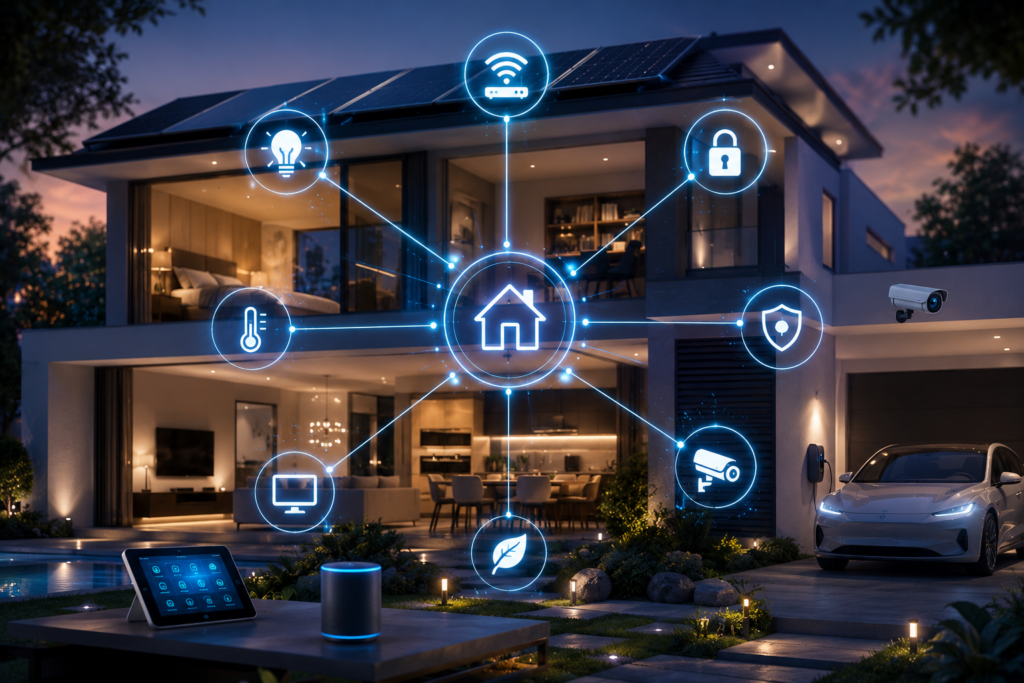
The Smart Home Market Is Growing Rapidly
Major research firms publish significantly different estimates for the global smart-home market because their methodologies, product categories, geographic coverage, and forecast periods differ.| Research firm | 2026 market estimate | Long-term forecast | Forecast CAGR |
|---|---|---|---|
| Mordor Intelligence | $164.13 billion | $311.22 billion by 2031 | 13.65% |
| MarketsandMarkets | $230.76 billion | $450.20 billion by 2032 | 11.8% |
| Grand View Research | $207.0 billion | $887.4 billion by 2033 | 23.1% |
How Many Homes Use Smart-Home Technology?
Household adoption is also difficult to measure with one universal number because surveys use different definitions of what counts as a smart home.Global Adoption
Statista projects global smart-home household penetration of approximately 82.1% in 2026, rising to about 92.5% by 2029.These are market forecasts, not a complete observed census of every household in 2026. The distinction is important when comparing market forecasts with survey-based adoption studies.U.S. and Canadian Adoption
The Association for Smarter Homes & Buildings (ASHB), based on a 2025 survey conducted by Harbor Research among 611 U.S. and Canadian consumers, reported smart-home adoption of 49% in 2024 and 59% in 2025.ASHB also noted that its sampling methodology was refined between the surveys. That means the 10-percentage-point change should not be interpreted as a pure measure of behavioral change without considering the methodology change.How Many Connected Devices Does a Household Have?
There is no single reliable universal number for the average U.S. smart home because device counts vary by survey definition and household type. Current industry research cited in 2026 includes estimates around six connected devices per household, while other surveys report higher counts for active smart-home users.Rather than treating one secondary-source number as a universal average, the safer conclusion is that households are using multiple connected devices and are increasingly combining them into larger ecosystems.Security and Access Control Remain Major Smart-Home Categories
Security and access control are among the most important smart-home segments.Grand View Research reports that security and access control represented approximately 31.0% of the global smart-home market in 2025, making it the largest product segment in that dataset.Common products include:- Smart security cameras
- Video doorbells
- Smart locks
- Motion sensors
- Alarm and monitoring systems
Matter Is Making Smart-Home Interoperability Better
One of the longstanding problems with smart homes has been fragmentation. Devices from different manufacturers often required separate apps, hubs, or incompatible automation systems.Matter is designed to reduce this problem. The Connectivity Standards Alliance describes Matter as an IP-based interoperability standard intended to improve how compatible smart-home devices work across supported ecosystems.Matter can allow compatible devices from different brands to work across supported smart-home ecosystems, reducing dependence on a single manufacturer’s platform. It does not guarantee that every device will work inside one universal app or that every feature will be available across every ecosystem.Matter 1.6 in 2026
Matter 1.6, released in June 2026, added further improvements to device setup, multi-ecosystem experiences, and context-driven control.For consumers, Matter compatibility is one of the strongest interoperability factors to consider when buying new smart-home devices. It should still be evaluated alongside security-update support, manufacturer reliability, local-versus-cloud control, privacy policies, and platform compatibility.How Broad Is Matter Support?
At the 2022 launch of Matter, the Connectivity Standards Alliance represented a community of more than 550 technology companies. That figure is historical launch context, not a current 2026 count of active Matter developers.Today, the CSA maintains a broader member ecosystem and a live certified-product program. That continuing certification activity is a more useful indicator of current ecosystem development than repeating the historical 550-company launch number as though it were a current adoption statistic.Connectivity Infrastructure: Wireless, Hybrid Networks, and Edge Computing
A smart home is only as reliable as the connectivity and processing infrastructure supporting it.Wireless and Hybrid Connectivity
Grand View Research reports that hybrid protocols represented approximately 41.1% of the smart-home connectivity market in 2025 within its defined category.Other connectivity segments are measured differently, so percentages from separate market categories should not be added together or interpreted as though they describe the same denominator.AI, IoT, 5G, and Edge Computing
Smart-home systems increasingly combine artificial intelligence, IoT connectivity, wireless networks, and edge processing.Edge processing can reduce latency and reduce the amount of data that must be sent to a cloud service, but privacy and offline functionality depend on the specific device architecture.For example, a device may perform some processing locally while still sending account, telemetry, video, or diagnostic data to a cloud service. Consumers should therefore review the manufacturer’s actual data-flow and connectivity documentation instead of assuming that “edge AI” automatically means private or fully offline operation.Asia Pacific Leads the Global Market in the Cited Data
Grand View Research reports that Asia Pacific held approximately 38.2% of global smart-home revenue in 2025 in its market definition and cites a growth trajectory of roughly 17% CAGR.Urbanization, smartphone adoption, connected-device availability, and investment in digital infrastructure can contribute to regional growth, but the relative importance of each factor varies by country.North America
Coherent Market Insights estimates North America at approximately 33.6% of its defined smart-home technologies market in 2026.Because that figure comes from a different research provider and market definition, it should not be directly compared with Grand View Research’s 38.2% regional revenue share as though both datasets use the same denominator.E-Commerce Has Become an Important Smart-Home Sales Channel
Mordor Intelligence reports that e-commerce platforms captured approximately 62.52% of smart-home product sales by revenue in 2025 in its dataset.That makes online comparison and purchasing increasingly important to smart-home adoption. Consumers can compare specifications, compatibility, reviews, security features, and prices across a much wider range of products than many physical stores can carry.However, a dominant e-commerce share does not prove that physical retail has become irrelevant or that online purchasing is the single defining reason for smart-home growth.Smart Thermostats and the Energy-Savings Case
Energy management is one of the smart-home categories where there is comparatively clear evidence of a measurable household benefit.ENERGY STAR says an ENERGY STAR-certified smart thermostat can reduce heating and cooling bills by about 8%, or roughly $50 per year on average. Savings can be higher in some homes, particularly where occupancy patterns allow the thermostat to make larger adjustments.Actual savings vary with factors such as:- Home size
- Climate
- HVAC system
- Occupancy patterns
- Energy prices
- Installation and device cost
- How actively the smart features are used
Smart-Home Privacy and Cybersecurity
As more home devices connect to apps, clouds, cameras, microphones, and external services, the security and privacy surface of the home also grows.Before Buying a Device, Check:
- Security-update policy: How long does the manufacturer promise software and security support?
- Account security: Does the platform support strong passwords and multi-factor authentication?
- Data collection: What information does the device collect?
- Data processing: Is information processed locally, in the cloud, or both?
- Retention: How long are video, audio, telemetry, or other records stored?
- Third-party sharing: Are data shared with service providers or other companies?
- Local control: Can important functions work if the cloud service is unavailable?
- End-of-life support: What happens if the manufacturer stops supporting the product or closes its cloud service?
Security Cameras and Microphones Deserve Extra Attention
Cameras and microphones can collect highly sensitive information about what happens inside and around a home.Before enabling these devices, review privacy settings, account security, storage options, access permissions, and whether recordings are uploaded automatically.A secure smart-home ecosystem is not just about whether devices can communicate. It is also about whether the people who own the devices can control who gets access to the information they generate.How to Build a Smart Home in 2026
1. Start With a Specific Need
Choose a problem to solve rather than buying devices simply because they are connected.Good starting points include:- Security monitoring
- Energy management
- Access control
- Lighting automation
- Comfort and scheduling
2. Check Compatibility Before Buying
Look for Matter compatibility when it fits your intended ecosystem, but also verify which controller, app, hub, or platform supports the features you actually need.3. Review the Security Policy
Check update commitments, privacy settings, account-security features, and cloud dependence before purchasing.4. Prefer Interoperability, but Do Not Ignore Manufacturer Support
A device may support Matter and still be a poor long-term choice if the manufacturer has weak security support, poor software maintenance, or limited warranty coverage.5. Start Small and Expand
Instead of automating an entire house at once, begin with a small set of compatible devices. Confirm reliability and usefulness before adding more.What the 2026 Smart-Home Market Really Shows
Several conclusions are well supported by the available data:- The global smart-home market is growing, although published market sizes differ substantially by methodology.
- Household adoption is becoming mainstream, but forecasts and survey results should not be presented as interchangeable.
- Security and access control remain major smart-home categories.
- Smart security cameras are among the faster-growing segments.
- Matter is becoming an important interoperability standard, with Matter 1.6 adding further functionality in 2026.
- Energy-management devices such as smart thermostats have clearer quantified savings evidence than many other smart-home categories.
- E-commerce is a major sales channel.
- Privacy, cybersecurity, cloud dependence, and manufacturer support are increasingly important purchasing considerations.
The Future of Smart Homes
The smart home is becoming more connected, but the most useful development may be the gradual reduction of friction between devices rather than any single breakthrough gadget.Interoperability standards such as Matter can make multi-brand systems easier to manage. Edge computing can reduce latency in some architectures. AI can help automate routines and detect patterns. Smart energy controls can help some households reduce consumption.At the same time, a more intelligent home is also a more connected data environment. Security updates, privacy controls, vendor support, and cloud dependence therefore deserve as much attention as convenience.The smart home of 2026 is best viewed as an ecosystem that should be designed deliberately, rather than a collection of gadgets bought independently.Conclusion
Smart-home technology is firmly moving into the mainstream, but the strongest evidence comes from combining market growth with practical adoption and technology developments rather than treating every forecast as an observed fact.Major research firms estimate the global smart-home market at between roughly $164 billion and $231 billion in 2026, depending on the market definition. Grand View Research estimates approximately $207 billion for 2026 within its own dataset.ASHB’s survey reported smart-home adoption among U.S. and Canadian households rising from 49% in 2024 to 59% in 2025, while Statista projects global household penetration of approximately 82.1% in 2026.Security and access control remain major categories, Matter continues to improve interoperability, and Matter 1.6 adds new capabilities in 2026. Smart thermostats also provide a relatively clear example of measurable energy savings, with ENERGY STAR estimating about 8% or roughly $50 per year on average for qualifying devices.For homeowners, the most practical strategy is simple: start with a real need, prioritize compatible devices, check the security and privacy model, and expand the system gradually.The smartest home is not necessarily the one with the most devices. It is the one whose technology works together reliably, provides useful benefits, and remains secure and manageable over time.Frequently Asked Questions
How much is the global smart-home market worth in 2026?
Estimates vary by research firm and market definition. Mordor Intelligence estimates about $164.13 billion, MarketsandMarkets about $230.76 billion, and Grand View Research about $207.0 billion for 2026.Is 82.1% smart-home adoption a measured 2026 figure?
No. Statista describes 82.1% as a 2026 market forecast for global household penetration. It should not be described as a completed census of households already using smart-home technology.How many smart devices does the average U.S. home have?
There is no single reliable universal figure because surveys use different definitions and samples. Current industry estimates vary, so it is safer to say that smart-home households typically use multiple connected devices rather than relying on one universal device count.What is Matter?
Matter is an IP-based smart-home interoperability standard from the Connectivity Standards Alliance. It is designed to help compatible devices from different brands work across supported smart-home ecosystems.Does Matter mean every smart-home device can use one universal app?
No. Matter improves interoperability, but actual controller, app, feature, and ecosystem support varies by device and platform.What is Matter 1.6?
Matter 1.6 was released in June 2026 and introduced further improvements to setup, multi-ecosystem experiences, and context-driven control.How much can a smart thermostat save?
ENERGY STAR says an ENERGY STAR-certified smart thermostat can reduce heating and cooling bills by about 8%, or approximately $50 per year on average. Actual savings vary by home, climate, HVAC system, occupancy, energy prices, and usage.Do smart thermostats always pay for themselves?
No. A smart thermostat can produce a meaningful energy-cost return over time, but the payback period depends on the device price, installation, energy savings, and household conditions.Are smart-home cameras safe for privacy?
They can be, but consumers should check security updates, account protection, cloud-storage settings, access permissions, data-retention policies, and the manufacturer’s privacy practices before using them.What should I consider before buying a smart-home device?
Check compatibility, security-update support, privacy and data collection, local versus cloud processing, account security, warranty and support, and what happens if the manufacturer discontinues the product or its cloud service.Sources
- Mordor Intelligence: Smart Homes Market Size, Growth, Share & Research Report 2031
- MarketsandMarkets: Smart Home Market Forecast
- Grand View Research: Smart Home Market Size, Share & Growth Report 2026–2033
- Statista: Smart Home Worldwide Market Forecast
- Association for Smarter Homes & Buildings: 2025 Smart Home Trends Survey
- Connectivity Standards Alliance: Matter
- Connectivity Standards Alliance: Matter 1.6, June 2026
- Connectivity Standards Alliance: Members
- Resideo: Matter Launch and 550-Company Historical Context
- ENERGY STAR: Smart Thermostats FAQs
- SQ Magazine: Smart Home Statistics 2026
- Coherent Market Insights: Smart Home Technologies Market